关于我们
|
致电:15023527951
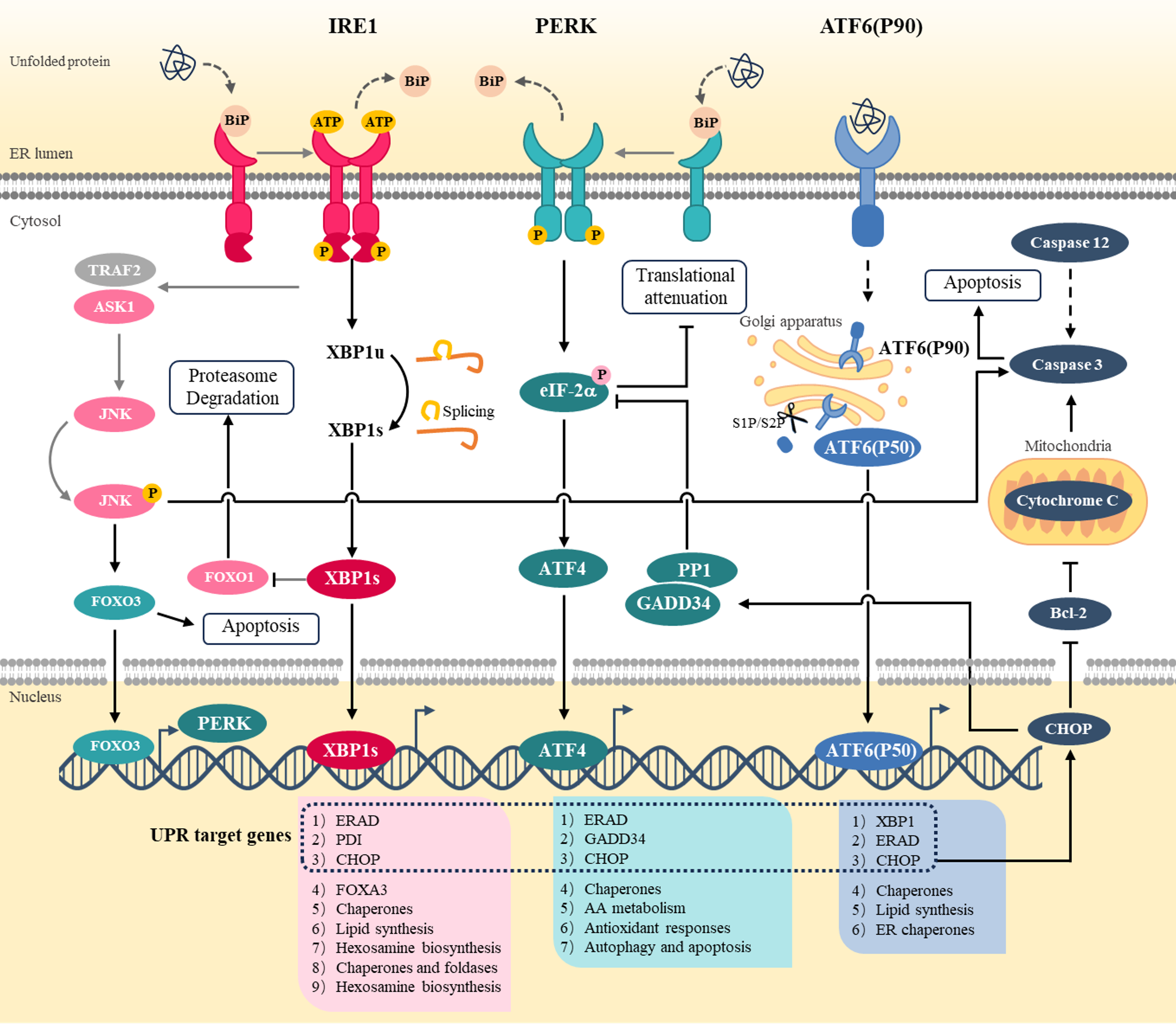
The UPR pathway is mediated by three classes of transmembrane sensor proteins located on the ER: IRE1, PERK, and ATF6. Under homeostatic conditions, these sensors remain inactive through binding to the chaperone protein Bip/GRP78. Upon ER stress, Bip dissociates from these sensors to bind misfolded proteins, thereby activating the receptors.
These three branches work in coordination to restore ER homeostasis: Activated PERK phosphorylates eIF2α, leading to a rapid halt in global protein translation, which reduces the protein-folding burden on the ER. IRE1, which possesses both kinase and ribonuclease activities, splices XBP1 mRNA to produce an active transcription factor that upregulates the expression of molecular chaperones and endoplasmic reticulum-associated degradation (ERAD) components, thereby enhancing protein folding and degradation capacity. ATF6 translocates to the Golgi apparatus, where it is cleaved and activated; it then moves to the nucleus to initiate the transcription of chaperones and folding enzymes.
Selected Reviews:
1、Alasiri, G., Fan, L.Y., Zona, S., Goldsbrough, I.G., Ke, H.L., Auner, H.W., Lam, E.W., 2018. ER stress and cancer: The FOXO forkhead transcription factor link. Mol Cell Endocrinol 462:67-81.
2、Chen, X., Cubillos-Ruiz, J.R., 2021. Endoplasmic reticulum stress signals in the tumour and its microenvironment. Nat Rev Cancer 21:71-88.
3、Chen, X., Shi, C., He, M., Xiong, S., Xia, X., 2023. Endoplasmic reticulum stress: molecular mechanism and therapeutic targets. Signal Transduct Target Ther 8:352.
4、Ko, D.K., Brandizzi, F., 2024. Dynamics of ER stress-induced gene regulation in plants. Nat Rev Genet 25:513-25.
5、Liu, C., Zhou, B., Meng, M., Zhao, W., Wang, D., Yuan, Y., Zheng, Y., Qiu, J., Li, Y., et al., 2021. FOXA3 induction under endoplasmic reticulum stress contributes to non-alcoholic fatty liver disease. J Hepatol 75:150-62.
6、Oakes, S.A., Papa, F.R., 2015. The role of endoplasmic reticulum stress in human pathology. Annu Rev Pathol 10:173-94.
 渝公网安备50009802001981
扫描二维码
 |